At 10 o’clock in the evening, most of the trucks have parked inside the gates to Eko Atlantic’s huge construction site. Under the light of street lamps, a number of Muslim drivers are praying, while others have rolled out thin mats directly on the ground and pulled a blanket over their heads.
As the roads are poor, the traffic is our greatest problem. Leaving the truck to mend a puncture can actually be dangerous.
The first stop for the day is the haulage company’s office and workshop in Ibadan, where Matthew and Gift pick up their loading order. The road there is regarded as one of the country’s main roads, but the asphalt has been patched up and is in poor condition and, even if the traffic is light in the morning, it takes them more than two hours to reach their destination.
When they have been given their loading order, Matthew leaves the main road and turns onto a smaller road, which eventually turns into a gravel road leading to the quarry.
“As the roads are poor, the traffic is our greatest problem. Leaving the truck to mend a puncture can actually be dangerous,” says Matthew.
Becoming a truck driver was actually my only opportunity, as I had no money to invest in a company of my own and my family didn’t have enough land to keep us all.
We pass a tanker that overturned in the opposite direction during the morning. The locals quickly removed its contents. Everything went well on this occasion, but it sometimes happens that a spark causes the flammable fuel to catch fire – with a number of casualties or even fatalities as a result.
The truck and a couple of other crash-damaged vehicles at the side of the road clearly illustrate Matthew’s description of the traffic climate in a country where no traffic rules appear to apply.
But Matthew drives calmly and safely. Back home in Lagos, he has a wife and four children – but he only sees them on Sundays.
“We work long hours and I can’t get home in the evening. The traffic in Lagos is far too chaotic. But, on Saturday evening, after work, I go home and spend Sunday with my family. We usually go to church.”
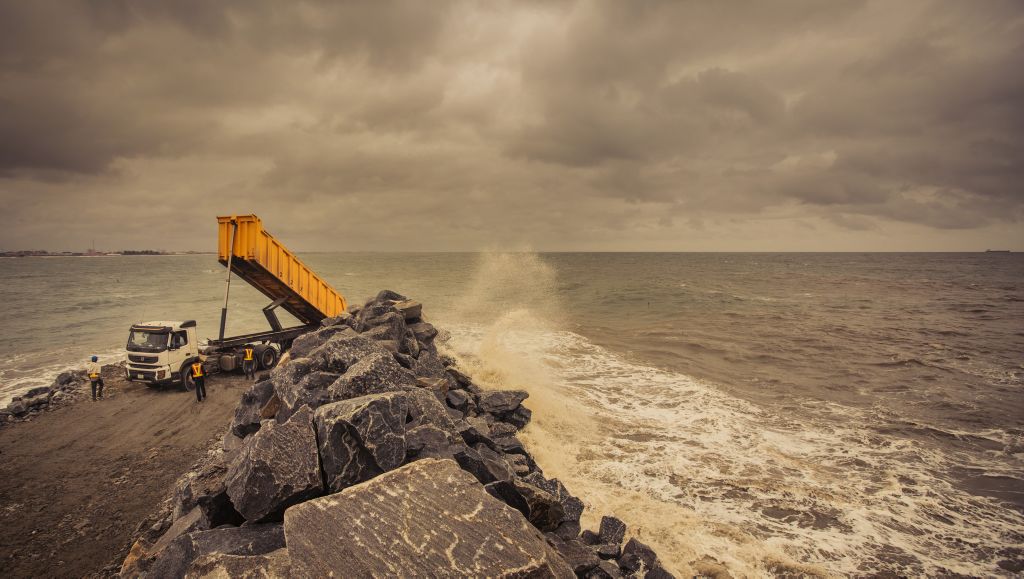
The daytime in Nigeria quickly turns to night and, when Matthew drives into the Eko Atlantic site, it is already dark. A long line of trucks has driven onto the quay to dump their cargo where the protective wall meets the sea.
Volvo FMX 6×4, tractor designed for heavy loads; hauler flat body from Meiller-Kipper; D13 Euro 3 engine with an output of 400 bhp.
Because of the inferior roads, the maximum speed of the Volvo trucks that are delivered to Nigeria is limited to 75 km/h.
Transport assignment: 50 trucks have so far been delivered to transport granite blocks to the large protective wall in Lagos that is being built round Eko Atlantic.