Where engines are born
2014-03-20
Visit Volvo’s engine plant in Skövde, Sweden, where all its engines are built, and meet the engineers behind the Euro 6 technology.

Trucks
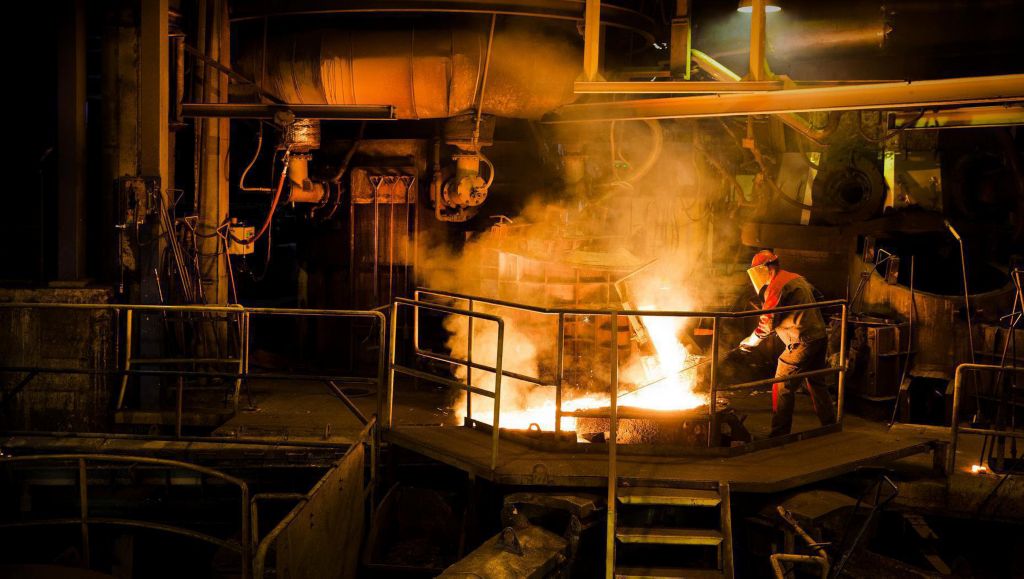
Fredrik Karlén folds down the visor on his helmet and lowers his slag rake into the open holding furnace. The molten metal has a temperature of 1,500 degrees Celsius and the staff are governed by stringent safety restrictions. This is G1, one of two foundries at the Volvo’s engine plant in Skövde, Sweden. At G1, raw materials – forging waste and casting waste from the plant are continuously fed into the top of the smelting furnace. To obtain the correct values in the molten iron, different alloys such as carbon and silicon, are added.
Like golden yellow rivers, the iron runs into pouring ladles, which are then taken to their final destination in the smelting plant, the casting furnaces for cylinder heads and cylinder blocks. It is here, in the midst of the smoke and sparks, in the dimly lit smelting plant, that truck engines are born.
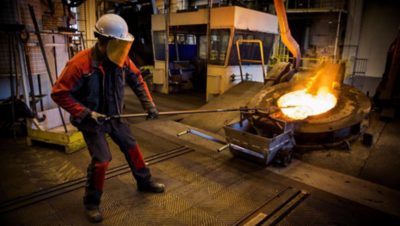
Every four minutes, new raw materials are tipped into the smelting furnace and, up in the control room, smelter Fredrik Karlén keeps an eye on the process.
“To produce a good engine, our values have to be absolutely perfect. At the smelting plant, people work their way up. The older staff members teach the younger ones. You start as an iron delivery boy, you then take care of a furnace and, finally, you may end up here in the control room,” says Fredrik Karlén, who started at assembly at Volvo Trucks in 1994 and moved to the smelting plant at G1 in 2009.
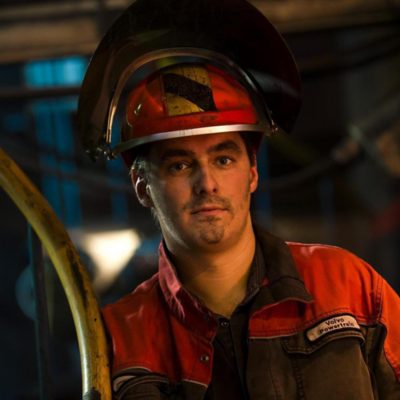
The first foundry in Skövde opened in 1868, G1 became operational in 1951 and, in August 2009, casting work began in the far more modern G2. The work is demanding, but the staff turnover rate is low. There is a feeling of craftsmanship and respect for the iron here.
“As far as we are concerned, the new Euro 6 engine will not involve that many changes. Our specifications for the iron values are going to change, but everything else will continue as usual,” says Fredrik Karlén.
When Europe’s most rigorous emission requirements for heavy-duty trucks came into force on 31 December 2013, they represented a significant sharpening of the regulations. Compared with Euro 5, emissions of nitrogen oxide (NOX) have been reduced by 80 per cent, while the emissions of particulate matter have been cut by 50 per cent. For the first time ever, the emission limits also have to be adhered to, regardless of the weather conditions and traffic situation.
To produce a good engine, our values have to be absolutely perfect. At the smelting plant, people work their way up. The older staff members teach the younger ones.
One of the main challenges for Volvo Trucks has been to comply with these rigorous requirements, without any deterioration in other important characteristics, such as ease of driving, efficiency, fuel consumption and truck service life.
“If a truck is stationary at the workshop because the emission technology is not up to scratch, the customer loses money. That’s why reliability and sustainability have been incredibly important parameters in the work Volvo Trucks has done on the Euro 6 engine,” says Mikael Karlsson, Chief Project Manager for the whole of the Euro 6 project at Volvo Group Trucks Technology (GTT).
In its development work, Volvo Trucks has been able to take advantage of its experience from the USA, where the emission standard corresponding to Euro 6 was introduced back in 2010. Among other things, trucks in the USA feature a combined EATS (Exhaust After Treatment System), a diesel particulate filter (DPF) and a catalytic converter, which reduce nitrogen oxide (SCR). In combination with Volvo Trucks’ existing Euro 5 engine, this technology has formed the basis of the new Euro 6 engine.
“One difference between our solution in the USA and the one we have chosen for Euro 6 is that, in the new engine, we pack the components in one silencer rather than two,” explains Lars-Olof Andersson, Project Leader Combustion at Volvo Group Trucks Technology (GTT).
Another challenge has been to comply with the requirement that emission values must never be exceeded, regardless of the weather conditions and traffic situation. The temperature of the exhaust gases normally varies, depending on whether the truck is driven empty or heavily laden, in slow city traffic or on open highways. However, to ensure stable emission levels of nitrogen oxide and particulate matter, the temperature of the emissions must never drop below 200 degrees Celsius. If the temperature is too low, it can be raised using EGR (Exhaust Gas Recirculation). This means that the hot exhaust gases are mixed with combustion air and returned to the engine. The newly heated exhaust gases are then forced into the aftertreatment system, where the correct temperature is reached.
If a truck is stationary at the workshop because the emission technology is not up to scratch, the customer loses money. That’s why reliability and sustainability have been incredibly important parameters in the work Volvo Trucks has done on the Euro 6 engine.
Euro 6 also sees the introduction of the specification for an internal system to keep a check on all the systems and functions in the truck. An external emission check is also required. Every year, truck manufacturers must test a certain number of trucks from each model range and this test is conducted using an emission meter which is connected to the exhaust pipe.
“The external check is conducted on a specific stretch of road and in real-life traffic. The trucks are driven in different traffic situations – otherwise known as a driving cycle. It has to include motorway driving, city traffic and hilly terrain,” explains Nitin Patel, Director Combustion Systems at GTT.

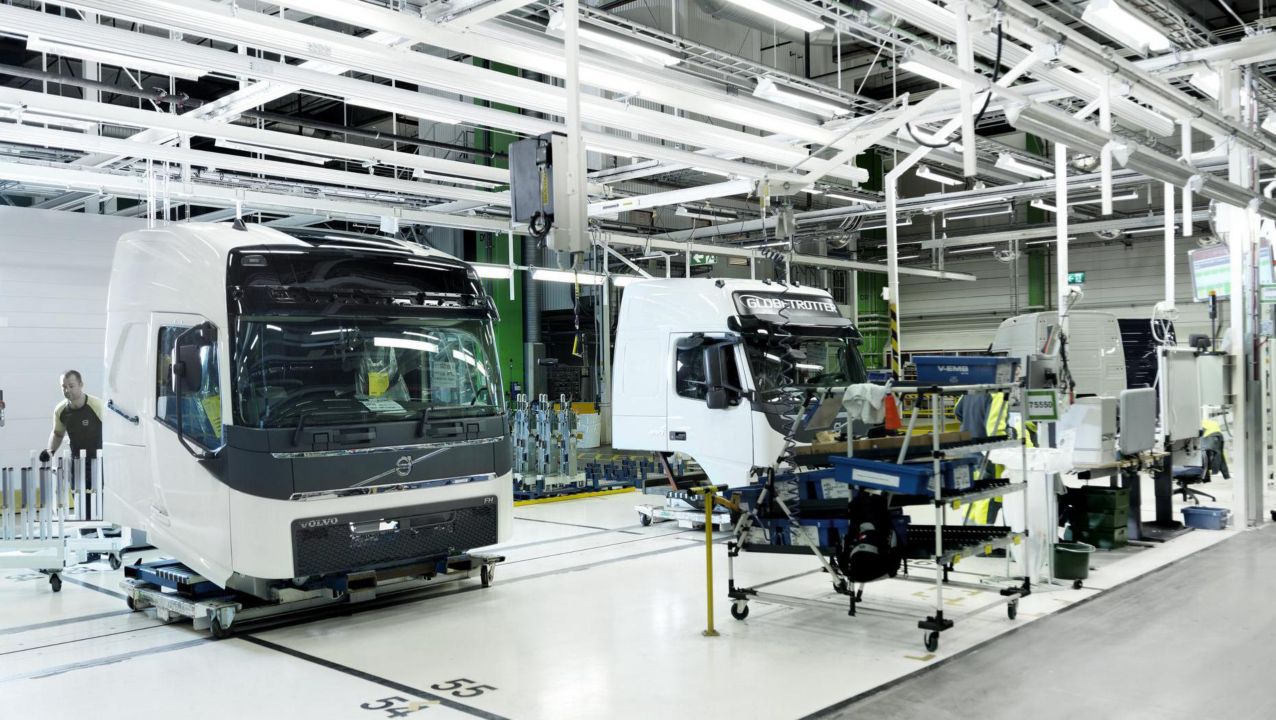
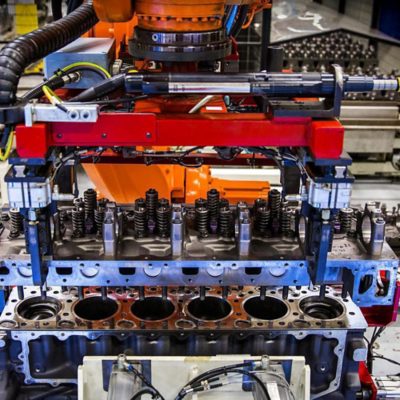
Euro 6 has not simply been a technical challenge. It has also necessitated the introduction of new assembly solutions at the engine plant in Skövde. New machinery has had to be constructed and additional stations have been included in the assembly process.
The cast engine parts arrive in the light and airy assembly hall, after being machined by robots. At assembly, it is almost silent. A few machines are buzzing and a lone radio can be heard, playing at low volume. This is where the engines for trucks that are sold all over the world are produced – half of them are Euro 6 engines, which are primarily manufactured for the European market. The Euro 5 engines that are still produced here have destinations outside of Europe.
“In conjunction with the introduction of Euro 6, we have a far wider range of articles, the work stations have been converted and we have brought in a new way to handle material,” says Henrik Andersson, an assembly worker who has been involved in designing the new assembly stations.
The production of the Euro 6 engines has been introduced at a calm tempo, where interest has constantly focused on securing the process and resolving the challenges that have emerged along the way.
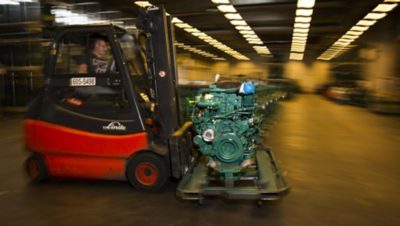
When the engine reaches the final station, it is subjected to a cold test and a trip to the paintshop, after which the finished engines are lined up in the warehouse to await transport to the Volvo Trucks’ plants in Tuve and Ghent.
It is cool, perhaps a little cold, out here, a far removed from the world of sparks and heat in which Fredrik Karlén takes away the slag from yet another smelt. The furnace operates around the clock and produces 30 tonnes of iron an hour for a total of 72,000 engines a year. The furnaces in the smelting plant at G1 never have a chance to cool.